Precision and Protection: Inside the High-Standard Manufacturing of SJ Valves
2026-01-16
Precision and Protection: Inside the High-Standard Manufacturing of SJ Valves
Precision and Protection: Inside the High-Standard Manufacturing of SJ Valves
- Q1 What is a safety valve?
- Q2. What is the working principle of a safety relief valve?
- SJ Manufacturing: High-Standard Production, Building a High-Quality Foundation for Safety Valves
- Conclusion
Q1 What is a safety valve?
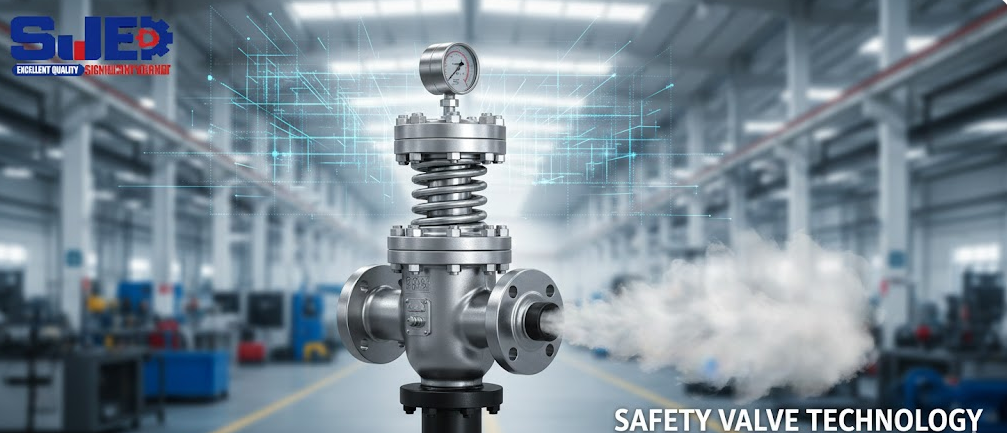
A safety valve is a special protective valve, often referred to as the "last line of defense" in industrial systems.
A safety valve is a special protective valve, often referred to as the "last line of defense" in industrial systems.
It is normally closed, and only opens automatically when the pressure in the system exceeds a preset safety limit (set pressure), using the pressure of the medium itself to quickly release excess fluid (gas or steam), preventing the container or pipeline from bursting or exploding due to excessive pressure. When the pressure returns to normal levels, it automatically closes and maintains a seal.
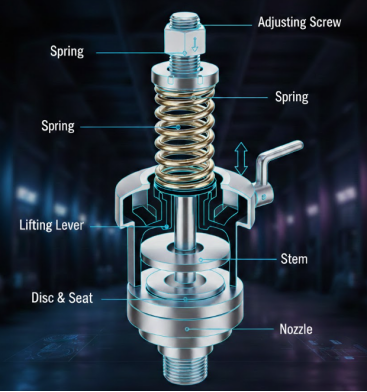
Key Components:
- Disc & Seat: The core of the seal. The disc acts like a stopper, pressing against the seat to prevent media leakage.
- Spring: The source of force. It generates a downward thrust, determining the pressure at which the valve opens (set pressure).
- Nozzle: The pressure inlet. The medium impacts the disc through this opening, and its size determines the rate of pressure relief.
- Stem: The force transmission pillar. It connects the spring and the disc, ensuring that the opening and closing action is straight up and down, without deviating from the center.
- Adjusting Screw: The adjustment knob. By tightening or loosening it, the spring pressure is changed, thereby adjusting the opening pressure.
- Lifting Lever: A testing tool. It is used to manually force the valve open to check if the internal components are stuck or jammed.
- Disc & Seat: The core of the seal. The disc acts like a stopper, pressing against the seat to prevent media leakage.
- Spring: The source of force. It generates a downward thrust, determining the pressure at which the valve opens (set pressure).
- Nozzle: The pressure inlet. The medium impacts the disc through this opening, and its size determines the rate of pressure relief.
- Stem: The force transmission pillar. It connects the spring and the disc, ensuring that the opening and closing action is straight up and down, without deviating from the center.
- Adjusting Screw: The adjustment knob. By tightening or loosening it, the spring pressure is changed, thereby adjusting the opening pressure.
- Lifting Lever: A testing tool. It is used to manually force the valve open to check if the internal components are stuck or jammed.
Q2. What is the working principle of a safety relief valve?
The working principle of a safety relief valve is based on the principle of pressure balance. When the system pressure exceeds a preset value, the valve automatically opens. This preset value is determined by the spring force of the valve and is typically higher than the normal operating pressure of the system.
The working principle of a safety relief valve is based on the principle of pressure balance. When the system pressure exceeds a preset value, the valve automatically opens. This preset value is determined by the spring force of the valve and is typically higher than the normal operating pressure of the system.
When the system pressure increases, the force acting on the valve disc increases, overcoming the spring force and causing the valve disc to lift off the valve seat. This allows the excess pressure to be released through the valve's outlet. Once the system pressure returns to a safe level, the spring force closes the valve disc, stopping the fluid discharge.
The valve is designed to reseat tightly when the pressure is within the safe range, preventing any fluid leakage. The spring force is adjustable, allowing the valve's set pressure to be calibrated according to the specific needs of the system.
In summary, the working principle of a safety relief valve is simple and effective, providing overpressure protection for pressurized systems and ensuring their safety and reliability.

Q3 SJ Manufacturing: High-Standard Production, Building a High-Quality Foundation for Safety Valves
SJ Valve safety valves are widely used in food and beverage, petrochemical, steel, metallurgy, power plants, and other fields, making them the ideal choice for overpressure protection of pipeline pressure vessels and equipment.
SJ Valve safety valves are widely used in food and beverage, petrochemical, steel, metallurgy, power plants, and other fields, making them the ideal choice for overpressure protection of pipeline pressure vessels and equipment.
- Safety Valve Machining Stage
The video shows the precision machining of key components of SJ safety valves. We understand that safety valves are the "last line of defense" for equipment, and even the slightest deviation in any link can determine success or failure. Therefore, SJ invests in high-standard processing equipment, constantly refining product reliability amidst sparks and chips. Every millimeter removed is our tribute to "zero-defect" quality.
The video shows the precision machining of key components of SJ safety valves. We understand that safety valves are the "last line of defense" for equipment, and even the slightest deviation in any link can determine success or failure. Therefore, SJ invests in high-standard processing equipment, constantly refining product reliability amidst sparks and chips. Every millimeter removed is our tribute to "zero-defect" quality.
- PMI Testing: "Identity Verification" of Material
Product reliability begins with its "genes." SJ Valve conducts PMI (Positive Material Identification) spectroscopic testing on all incoming raw materials and processed parts.
Product reliability begins with its "genes." SJ Valve conducts PMI (Positive Material Identification) spectroscopic testing on all incoming raw materials and processed parts.
Strict Standards: Technicians use a portable spectrometer to perform real-time testing on the valve body, clearly displaying the percentage of key alloy elements such as chromium (Cr), nickel (Ni), and molybdenum (Mo) on the screen.
SJ Commitment: Only materials whose chemical composition fully meets ASME or national standards can proceed to the next process, eliminating the risk of corrosion or failure due to material misuse from the source.
- PT and UT: In-Depth "Non-Destructive Examination"
For subtle defects that may exist inside and on the surface of the valve body, SJ adopts a dual "examination" mechanism:
For subtle defects that may exist inside and on the surface of the valve body, SJ adopts a dual "examination" mechanism:
PT Penetrant Testing: The red coloring process shown in the video is our PT testing. By coloring key sealing surfaces such as the valve seat and valve disc with a penetrant, any surface cracks, pores, or looseness that are difficult to detect with the naked eye will be revealed.
UT Ultrasonic Testing: If PT is about looking at the surface, then UT is like an "ultrasonic B-scan." SJ conducts 100% ultrasonic internal flaw detection on forged parts according to ASME V standards. Through the waveform diagram fed back by high-frequency sound waves, we can accurately detect whether there are hidden defects such as inclusions and delamination inside the metal, ensuring the structural strength of the valve body is foolproof.


Conclusion
From spectroscopy to waveform analysis, from penetration testing to precision machining, SJ's strict adherence to standards is almost obsessive. We believe that only safety valves that have undergone the most rigorous testing can remain stable and reliable under pressure.
From spectroscopy to waveform analysis, from penetration testing to precision machining, SJ's strict adherence to standards is almost obsessive. We believe that only safety valves that have undergone the most rigorous testing can remain stable and reliable under pressure.