Smooth Flow, Zero Leakage: Full-Scenario Selection Guide and Hardcore Technology Analysis of SJ VALVE Gate Valves
Smooth Flow, Zero Leakage: Full-Scenario Selection Guide and Hardcore Technology Analysis of SJ VALVE Gate Valves
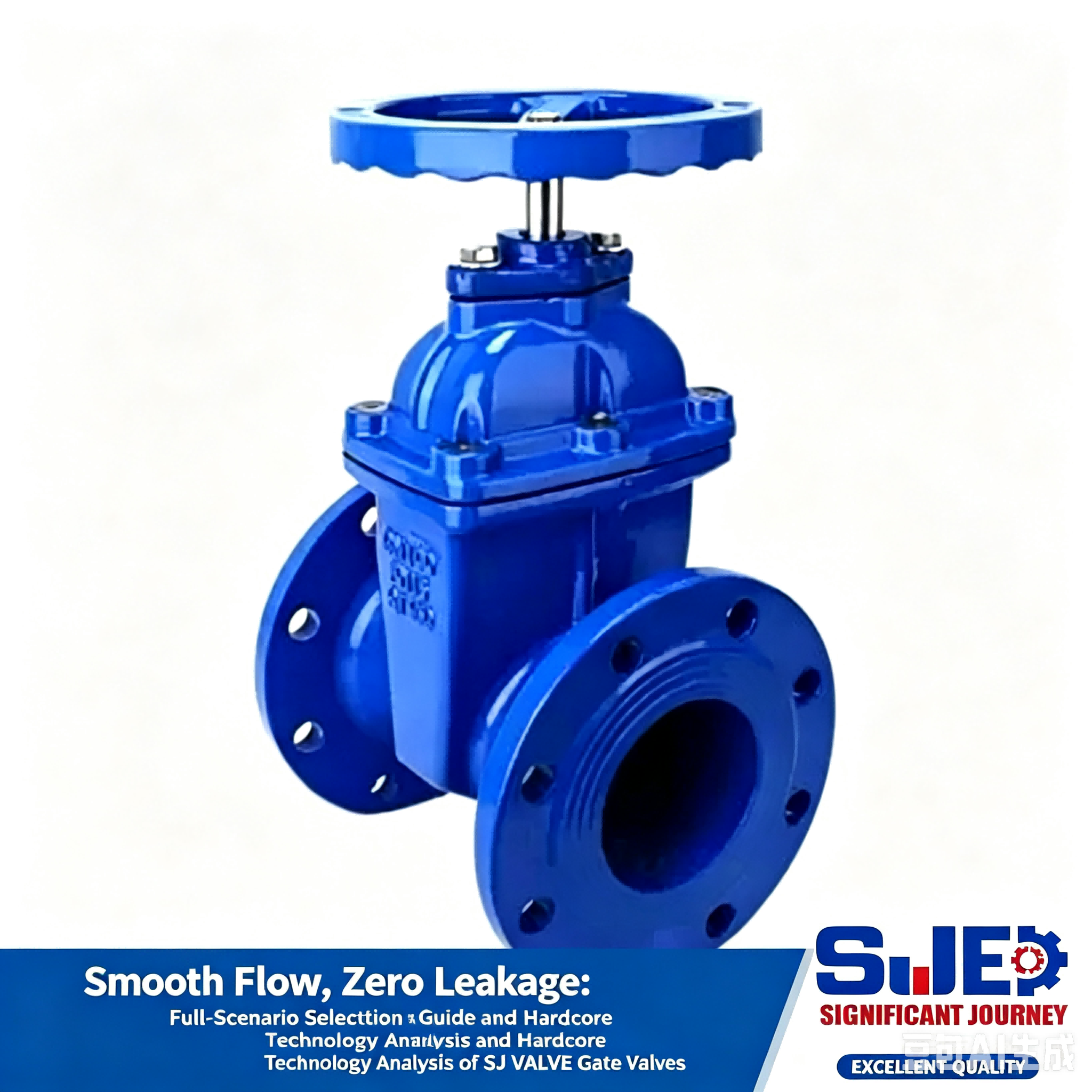
what is a gate valve? According to the Chinese National Standard Valve Terms combined with general industry technical manuals, a gate valve is defined as one of the most commonly used isolation valves. Its closing element is a gate (resembling a sluice gate), which moves up and down vertically to control the on/off status of the fluid within the pipeline.As a critical component in piping systems for controlling media flow, the gate valve achieves a fully open or fully closed state by driving the gate up and down via the valve stem. It features minimal fluid resistance and provides highly reliable bidirectional sealing.
| BRAND |
| NEWAY |
| GTFM |
| SUFA |
| STV |
| SJ |
-
Q1: What are the respective applications for Cast Iron, Cast Steel, and Stainless Steel valve bodies? What are the consequences of making the wrong choice?
-
Q2: Is the fluid resistance of a gate valve really that small? Why can it achieve bi-directional sealing?
-
Q3: What connection methods are typically paired with Cast Iron, Cast Steel, and Stainless Steel gate valves respectively? What are the differences between flanged, threaded, and welded connections?
- Conclusion
Q1: What are the respective applications for Cast Iron, Cast Steel, and Stainless Steel valve bodies? What are the consequences of making the wrong choice?
A: Selecting the wrong valve body material can result in premature valve failure at best, and catastrophic safety accidents at worst. It must be approached with the utmost caution.
Grey cast iron is the most economical option but is relatively brittle and has low strength (tensile strength is only 200–250 MPa). It is suitable for pressures not exceeding 1.6 MPa and temperatures not exceeding 80°C, and is primarily used in ambient-temperature, low-pressure applications such as building water supply, fire protection, and HVAC systems. If mistakenly used in steam systems or high-pressure environments, the valve body could rupture or burst at any moment.
Cast steel (WCB) offers high strength and excellent toughness. It is suitable for pressures ranging from 1.6 to 10 MPa and temperatures up to 425°C. It can withstand water hammer impacts and vibration in industrial pipelines, making it the most commonly used material for industrial applications such as steam systems, oil and gas, and high-temperature water lines. It is important to note that cast iron gate valves are strictly prohibited for steam service, whereas cast steel performs far more reliably under vibration and water hammer conditions.
Stainless steel offers exceptional corrosion resistance but comes at the highest price (typically 5 to 10 times that of cast iron). It is designed for corrosive environments involving acids, alkalis, seawater, and food-grade media. For marine/seawater environments, 316L or higher must be specified, as 304 will still rust under chloride ion conditions. It is recommended to select the material based on the specific corrosiveness of the medium: choose stainless steel for acids, cast steel for steam, and cast iron for clean water.
Q2: Is the fluid resistance of a gate valve really that small? Why can it achieve bi-directional sealing?
A: The core advantage of a gate valve designed for fully open or fully closed operation indeed lies in its extremely low fluid resistance. You can refer to the comparison diagram below illustrating the fluid resistance between a gate valve and a globe valve. When a gate valve is fully open, the wedge is completely retracted, making the flow path straight and unobstructed. As a result, the medium passes through in a straight line with almost no resistance, keeping pressure loss exceptionally low. In contrast, the fluid inside a globe valve must turn 180° within the valve body, leading to a flow resistance coefficient that is several times higher. Gate valves should not be used for flow regulation. If left partially open for extended periods, the high-velocity medium will severely scour and vibrate the wedge and sealing faces like an "erosion" process, which can destroy the seal within months. This must be strictly noted during selection and application.
As for bi-directional sealing, this is achieved thanks to the symmetrical left-and-right structure of the gate valve. The medium can flow in from either side. When closed, the medium pressure pushes the wedge against the seat, making the seal tighter as pressure increases. The inclined design of the wedge further enhances this self-tightening sealing effect, ensuring tighter seals under high pressure. This eliminates any leakage caused by installing the valve in the wrong flow direction, making the pipeline layout much more flexible.
SJ VALVE’s wedge gate valve series precisely capitalizes on these two key features—the full-bore design minimizes fluid resistance to the lowest possible level, while the precision wedge structure achieves zero leakage under high pressure. Additionally, it utilizes wear-resistant and anti-corrosive packing to significantly extend maintenance-free intervals, allowing your pipeline to truly achieve "unobstructed flow and zero-leakage closure."
The following table shows the comparative data of fluid resistance between gate valves and globe valves:
|
Comparison Item |
Gate Valve (Fully Open) |
Globe Valve (Fully Open) |
|
Flow Resistance Coefficient |
0.08 ~ 0.12 |
2.4 ~ 6.0 |
|
Resistance Multiplier |
Reference Value |
Approximately 3 to 5 times that of a gate valve |
|
Fully Open Flow Path Form |
Straight-through, nearly like a straight pipe |
S-shaped flow path, medium turns 180° |
Also refer to https://www.facebook.com/share/r/196MxcjRyj/ ,which demonstrates the operational states of gate valves and globe valves.
Q3: What connection methods are typically paired with Cast Iron, Cast Steel, and Stainless Steel gate valves respectively? What are the differences between flanged, threaded, and welded connections?
A: Material determines how much pressure and temperature a valve can withstand, while the connection method determines whether the valve can be stably and reliably integrated into the pipeline. The material of a gate valve and its connection method must be matched into the most suitable combination.
Cast iron gate valves primarily use flanged connections, which are convenient for installation and disassembly, making them suitable for medium to large-sized pipelines such as municipal water supply/drainage and HVAC. For small diameters below DN50, threaded connections can be selected (low cost, fast installation), and grooved clamp connections are also very common in fire protection engineering.
Cast steel gate valves require selecting the connection based on pressure. Welded connections are the preferred choice for high-pressure industrial pipelines, offering a permanent fix with zero leakage, capable of withstanding extreme temperatures and pressures. This connection is used in long-distance oil and gas transmission pipelines and high-temperature steam lines in power plants. For medium and low-pressure process pipelines that require regular maintenance, flanged connections are more practical.
Stainless steel gate valves can use all three connection methods, and the selection depends on the pipeline installation conditions and application requirements. If the medium is highly corrosive, welding combined with passivation treatment is currently the best solution for corrosion prevention. Flanges are used when maintenance is required, and threads are used for small diameters with low corrosiveness.
It is worth mentioning that in the 2011 national standard amendment announcement, there is an important correction: the original standard Article 4.6.4 stated that "For gate valves with a nominal pressure greater than PN25 or a nominal size greater than DN65, the connecting flanges of the valve body and valve cover shall be circular," which was corrected to "For gate valves with a nominal pressure greater than PN25 and a nominal size greater than DN65..." (changing "or" to "and").
The three connection methods each have their own emphasis:flanged connections (flanged discs designed for "detachable connection and sealing") are easy to assemble/disassemble and offer reliable sealing, but the flanged discs and bolts required for this detachable connection carry a higher cost, and bolts/gaskets are prone to creep and relaxation in high-temperature environments above 350°C, posing a leakage risk. Welded connections provide a permanent fix with virtually zero leakage, but they cannot be disassembled for maintenance, requiring the pipeline to be cut to replace the valve. Threaded connections offer the lowest cost and fastest installation, but they are not suitable for large pipe diameters (usually ≤DN50) and carry a leakage risk under vibration or temperature changes. See the reference below:

SJ VALVE gate valve are available in various connection methods, including flanged, welded, and threaded. Whether the piping class is Class 150 or Class 2500, they can match the most suitable solution, meeting needs ranging from municipal clean water to high-temperature refining media.
Conclusion
: As the "sluice gate" of a piping system, the core of a gate valve lies in its low fluid resistance, fully open/closed operation, and bi-directional sealing. SJ VALVE offers a complete series of materials ranging from cast iron to stainless steel, paired with multiple connection solutions such as flanged, welded, and threaded, fulfilling all-scenario requirements from municipal clean water to highly corrosive industrial media. Selecting the right gate valve provides the most fundamental guarantee for pipeline safety and efficiency.