Protecting Your Piping Systems: The Ultimate Guide to Selection and Application of Industrial Check Valves
Protecting Your Piping Systems: The Ultimate Guide to Selection and Application of Industrial Check Valves
Protecting Your Piping Systems: The Ultimate Guide to Selection and Application of Industrial Check Valves
Introduction
In the design and procurement of modern fluid control systems, we often need to return to the most fundamental engineering questions: what is check valves, and what are the functions of the valves? By definition, valves are mechanical devices that control the flow, pressure, and direction of media within a piping system. Their core functions include opening, isolating, regulating, throttling, and preventing backflow.
1.Emerson
Emerson is a global leader in fluid automation and process control, commanding a massive market share through premium legacy brands under its umbrella. The company excels in engineering heavy-duty, highly engineered check valves designed to handle severe service, high pressures, and volatile media across the petrochemical, chemical, and power industries.
Crane Co. is an absolute benchmark in the check valve industry, widely recognized for setting global standards in non-return valve design. Its famous Duo-Chek (dual-disc wafer check valves) and Noz-Chek (nozzle check valves) series are legendary for their superior dynamic response and water-hammer mitigation, making Crane the go-to brand for modern piping engineers.
3.Velan
Velan is renowned worldwide for its premium manufacturing capabilities in severe-service, high-pressure, and extreme-temperature valves. Their swing and piston check valves feature exceptionally robust forge and cast designs, securing a dominant position in high-stakes industries such as nuclear power, cryogenic applications, and superheated steam pipelines.
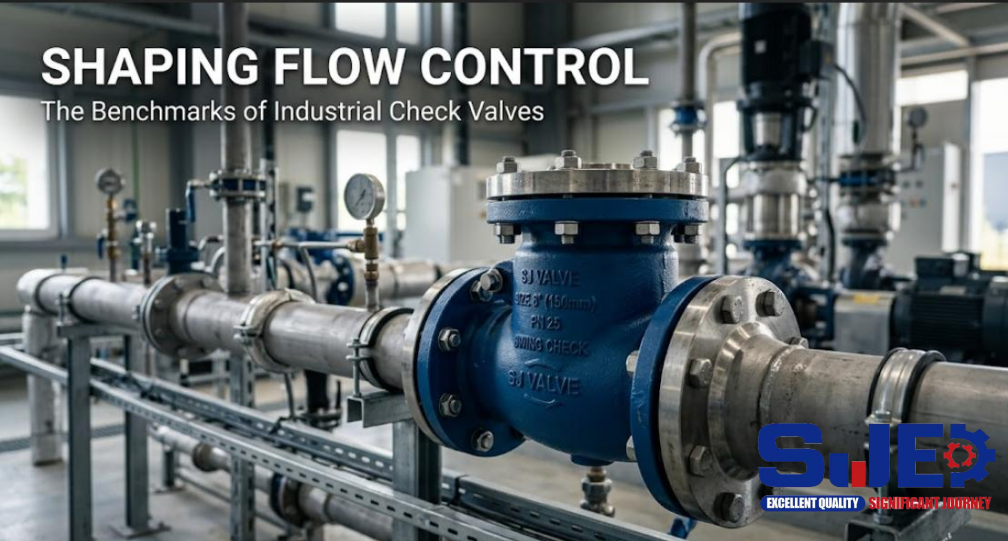
4.SJ Valve
SJ Valve specializes in engineering and manufacturing high-performance non return valve that set the standard for reliability, safety, and fluid efficiency. Designed to prevent backflow and protect critical pumping infrastructure, our check valve series serves globally in water treatment, municipal engineering, chemical processing, and HVAC systems.

Within the vast valve family, there is an unsung hero that operates completely on fluid velocity without manual intervention or external power—the check valve. For international buyers and project managers, having a clear understanding of what is a check valve and what do check valves do is the cornerstone of building a safe and efficient pipeline network. This guide breaks down the core mechanics and critical selection criteria of this essential component.
Q1: In pipeline engineering, what is the core purpose of a check valve, and what system pains does it solve?
A: Every rigorous pipeline design begins with a precise grasp of the purpose of check valve installation. In practical industrial applications, its main purposes and solutions to critical system pain points include:
-Protecting Expensive Equipment from Reverse Flow: When a pump stops abruptly, downstream fluid rushes back due to gravity. The primary purpose of a check valve is to cut off this backflow instantly, preventing the reverse fluid from spinning the pump backward and burning out the motor.
-Mitigating Destructive Water Hammer: When backflow occurs and is suddenly slammed shut, it generates massive pressure shockwaves. A properly selected check valve absorbs and minimizes this kinetic energy, preventing pipe vibration or cracking.
-Maintaining System Pressure and Preventing Cross-Contamination: In parallel pumping or multi-line systems, check valves maintain pressure in specific lines and prevent harmful wastewater from siphoning back into clean process lines.
At SJ Valve, we engineer our check valves specifically to address these field challenges. By optimizing the hydrodynamic closure speed of our products, SJ Valve ensures your high-value pumps and pipeline integrity are fully protected against severe hydraulic shocks.

Q2: How do different structural designs perform their duties?
A: When exploring what do check valves do, the ultimate mission of all check valves is to allow unidirectional flow and prevent reverse flow. However, different structural designs fulfill this duty in distinct ways:
-Swing Check Valves: Featuring a disc that swings open on a hinge pin, this design offers a straight-through flow path with minimal flow resistance. It is the classic solution for large-diameter, stable-flow pipelines handling water or industrial slurries.
-Silent / Axial Flow Check Valves: The disc moves linearly along a center axis, assisted by a heavy-duty spring. Because its closing stroke is extremely short, it closes the exact split-second before fluid flow hits zero, making it the absolute best choice for eliminating destructive water hammer.