Actuator Selection: SJ helps you choose the ideal actuator for your valve
2024-11-07
Actuator Selection: SJ helps you choose the ideal actuator for your valve
Actuator Selection: SJ helps you choose the ideal actuator for your valve
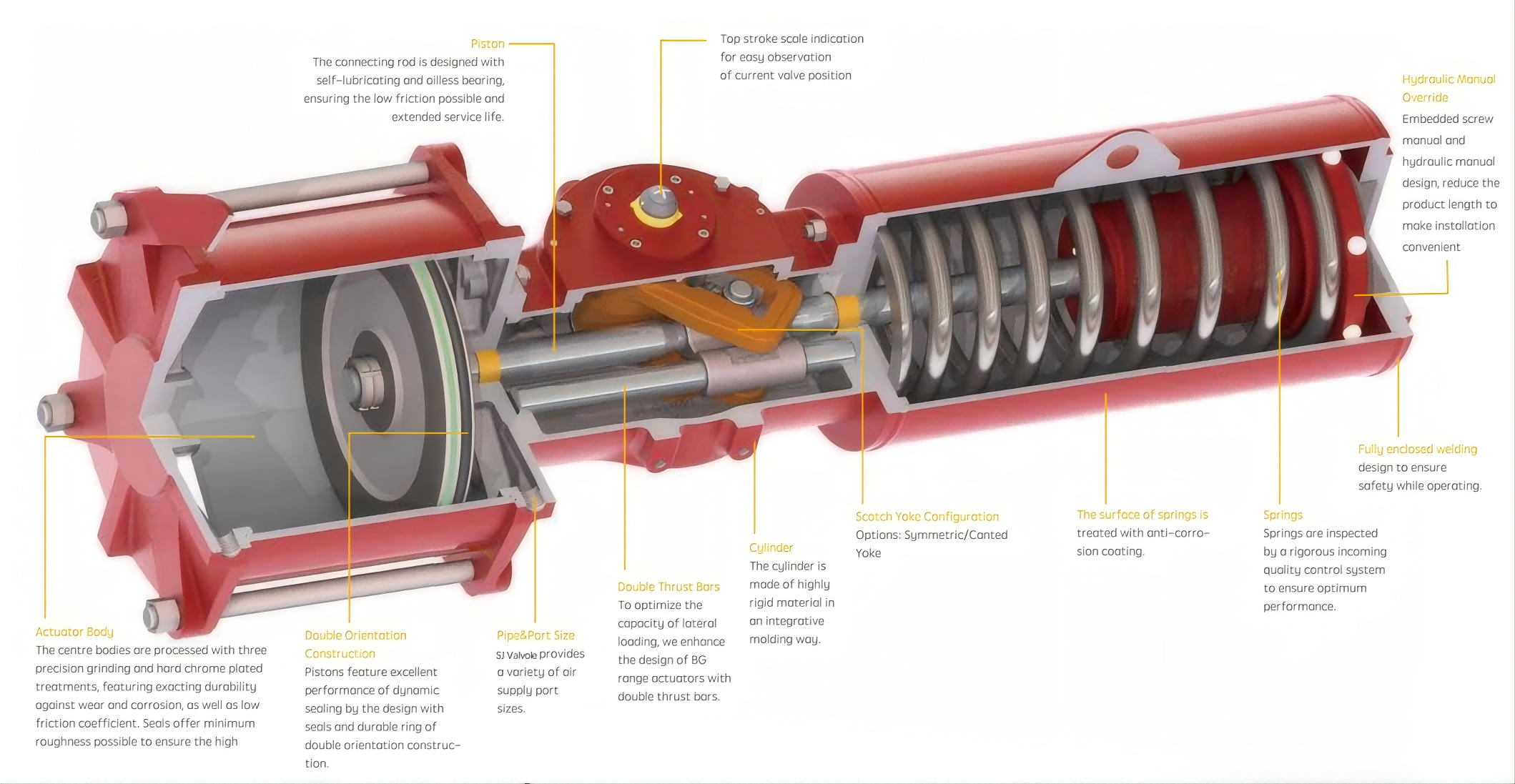
An actuator is a machine or assembly mounted on top of an industrial valve that is used to automatically move and control the valve. The performance of a valve depends to a large extent on its actuator. Engineers need to consider three important factors when selecting an actuator: operating frequency, ease of access, and critical functions. The valve actuator should perform a variety of functions, including moving the valve closing member into place, holding the valve closing member in the desired position, providing sufficient force or torque to hold the closing member in place and meet the desired closing leak level, providing full open or full closed or failure mode as is, or providing a certain amount of closing member rotation at an appropriate speed. Typically, actuators can be hydraulic, pneumatic, or electric. The mechanism, advantages and disadvantages of these three actuators are discussed in this paper. Actuator selection parameters that are affected include power availability, valve torque and size, failure mode, operating speed, operating frequency and ease of use, control accessories, hazard areas and cost, and power availability.
Type of Actuator
Electric Actuator
The electric push rod is designed to convert electrical energy directly into mechanical motion. Applications of electric push rods include robotic technology, automotive systems and machinery. Electric push rods provide precise control, high efficiency and can be easily integrated with automated systems.

Advantages
-
The electric actuator has good accuracy in terms of valve movement and function, and can monitor the percentage of valve opening.
-
Unlike pneumatic and hydraulic actuators, all control components are integrated in the actuator.
-
Electric actuators are cheaper, more compact, and lighter than pneumatic and hydraulic actuators
Disadvantages
-
Electric actuators cannot maintain a fail-safe position unless combined with hydraulic power (electro-hydraulic actuators).
-
Compared to pneumatic and hydraulic actuators, electric actuators contain more complex and sensitive components.
-
Electric actuators are less economical than pneumatic or hydraulic actuators of some sizes.
-
Electric actuators require more certification in hazardous areas with explosive liquids such as ATEX. ATEX stands for Explosive Environment and is an EU directive covering equipment and protection systems for use in potentially explosive environments.
Pneumatic Actuator
Pneumatic actuators use the energy of compressed air to generate rotational and linear motion to operate valves and dampers. In the broadest sense, a cylinder is a pneumatic actuator. Most pneumatic actuators use some standard components that are easy for technicians to maintain

Motion control applications that use rotary pneumatic actuators are typically rack-and-pinion or paddle designs. Double-acting rack and pinion arrangements are often used. Multi-position, three -, four -, or five-stop drives are commonly used for sequential assembly operations. Rotary drivers can also be used for indexing, stepping, picking and placing movements.