How Does a Ball Valve Work
2025-12-26
How Does a Ball Valve Work
How a Ball Valve Works
- What are the basic components of a ball valve?
- What are the working principles of the main components of a ball valve?
- How to correctly operate and determine the status of the ball valve?
- Why Choose a Ball Valve?
A ball valve, as the name suggests, is a valve that uses a ball to control the flow of fluid from one opening to another. The ball has a port, sometimes called an orifice, in its center. When the center port is aligned with the direction of the connected pipe, the ball valve is open, allowing fluid or gas to flow freely. When the center port is perpendicular to the pipe direction, the ball valve is closed, blocking the fluid passage and preventing further fluid flow.

Q1 What are the basic components of a ball valve?
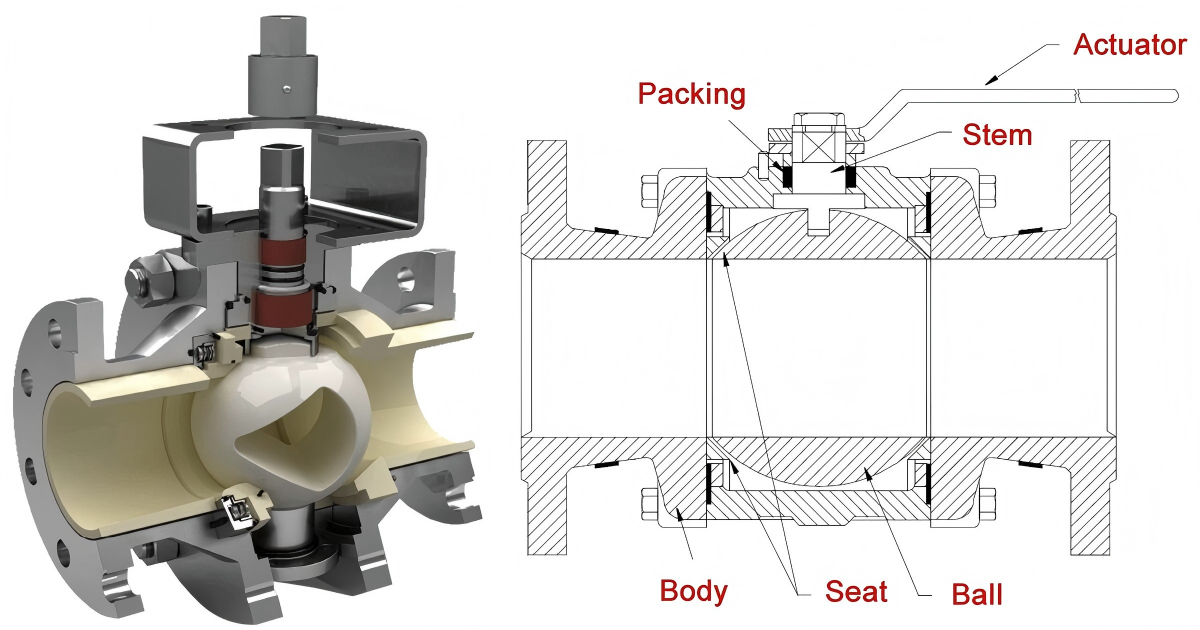
A typical ball valve consists of several key components that work together to achieve its function. The ball itself (the valve's closing element) has a central bore inside. This bore is located between two valve seats (annular seals) to ensure a leak-proof seal when the valve is closed. The valve stem connects the ball to an external handle or actuator, allowing rotational motion to be transmitted to the ball. The valve body houses these internal components and has inlets and outlets for connection to the pipeline. When the handle is rotated to the open position, the central bore of the ball aligns with the fluid path, allowing fluid to flow; in the closed position, the central bore rotates 90° to completely block fluid flow. The handle itself clearly indicates the valve status—generally, when the handle is parallel to the pipeline, the valve is open; when the handle is perpendicular to the pipeline, the valve is closed.
A typical ball valve consists of several key components that work together to achieve its function. The ball itself (the valve's closing element) has a central bore inside. This bore is located between two valve seats (annular seals) to ensure a leak-proof seal when the valve is closed. The valve stem connects the ball to an external handle or actuator, allowing rotational motion to be transmitted to the ball. The valve body houses these internal components and has inlets and outlets for connection to the pipeline. When the handle is rotated to the open position, the central bore of the ball aligns with the fluid path, allowing fluid to flow; in the closed position, the central bore rotates 90° to completely block fluid flow. The handle itself clearly indicates the valve status—generally, when the handle is parallel to the pipeline, the valve is open; when the handle is perpendicular to the pipeline, the valve is closed.
SJ Summary: SJ ball valve primarily achieves fluid opening and closing through a port (or bore) in the center of its internal ball. When the port aligns with the pipeline, fluid can flow freely; when rotated to the perpendicular direction, the fluid is blocked.
Q2. What are the working principles of the main components of a ball valve?
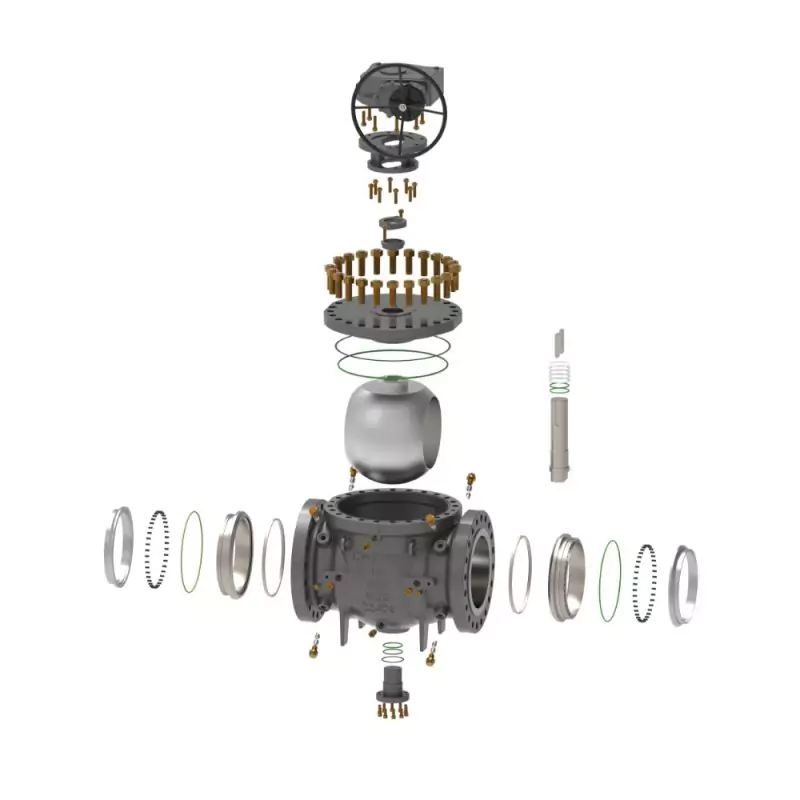
Ball: A ball with a central hole, used for closing the valve.
Stem: Connects the handle and the ball, allowing the ball to rotate.
Seat: A ring-shaped structure surrounding the ball (usually made of PTFE), providing a seal when the valve is closed and allowing smooth rotation when the valve is open.
Handle/Lever: Attached to the stem; rotating 90 degrees operates the valve.
Ball: A ball with a central hole, used for closing the valve.
Stem: Connects the handle and the ball, allowing the ball to rotate.
Seat: A ring-shaped structure surrounding the ball (usually made of PTFE), providing a seal when the valve is closed and allowing smooth rotation when the valve is open.
Handle/Lever: Attached to the stem; rotating 90 degrees operates the valve.
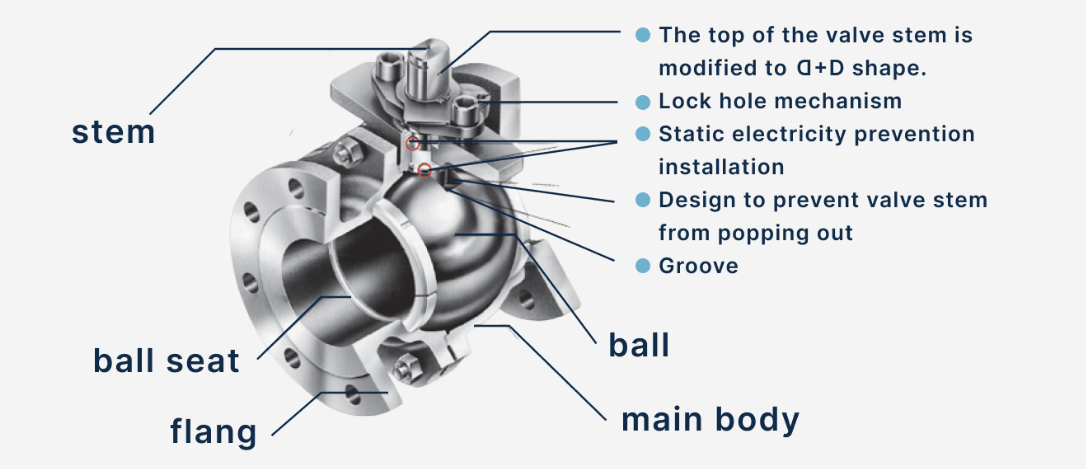
- Stem: The stem connects the actuator (e.g., handle or actuator) and the ball.
- O-ring: O-rings in ball valves are circular seals made of materials such as rubber. They prevent leakage by forming a tight seal between components, such as around the stem or seat.
- Valve Body: The valve body supports all the internal components of the valve and protects them from application and environmental conditions. The valve body typically has openings for connecting pipes, called the inlet and outlet. Valve bodies are made of robust and durable materials such as brass, stainless steel, or PVC.
- Ball: The ball has an orifice through which fluid flows when the valve is open. This orifice aligns with the valve's direction of operation, allowing fluid to pass through. When the orifice is perpendicular to the direction of fluid flow, it blocks fluid flow.
- Seat: The seat supports and seals the ball. Ball valves typically have two seats. When the valve is closed, these seats form a tight seal around the ball. The upstream seat prevents fluid pressure from entering, while the downstream seat prevents fluid from leaking into the atmosphere.
- O-ring: O-rings in ball valves are circular seals made of materials such as rubber. They prevent leakage by forming a tight seal between components, such as around the stem or seat.
- Valve Body: The valve body supports all the internal components of the valve and protects them from application and environmental conditions. The valve body typically has openings for connecting pipes, called the inlet and outlet. Valve bodies are made of robust and durable materials such as brass, stainless steel, or PVC.
- Ball: The ball has an orifice through which fluid flows when the valve is open. This orifice aligns with the valve's direction of operation, allowing fluid to pass through. When the orifice is perpendicular to the direction of fluid flow, it blocks fluid flow.
- Seat: The seat supports and seals the ball. Ball valves typically have two seats. When the valve is closed, these seats form a tight seal around the ball. The upstream seat prevents fluid pressure from entering, while the downstream seat prevents fluid from leaking into the atmosphere.
SJ Summary: SJ's use of high-strength materials (such as stainless steel and PVC) ensures the durability of the valve body in various complex applications, while the precision valve seat and O-ring design are the core guarantees for achieving "zero leakage".
Q3. How to correctly operate and determine the status of the ball valve?
Open: The handle is parallel to the pipe. The orifice of the ball is aligned with the pipe, allowing fluid to flow freely.
Closed: The handle is perpendicular to the pipe. The ball rotates 90 degrees, blocking the orifice on its solid side and preventing fluid flow.
Open: The handle is parallel to the pipe. The orifice of the ball is aligned with the pipe, allowing fluid to flow freely.
Closed: The handle is perpendicular to the pipe. The ball rotates 90 degrees, blocking the orifice on its solid side and preventing fluid flow.

SJ Summary: SJ emphasizes that the rapid 90-degree rotation not only improves work efficiency, but the visual indication provided by the handle position also greatly reduces the risk of misoperation.
Q4. Why Choose a Ball Valve?
Ball valves are popular due to their compact design, low maintenance costs, lack of lubrication, and ability to achieve a tight seal with minimal torque. Among all valve types, ball valves are also the most economical choice.
The biggest drawback of ball valves is that most designs have poor throttling performance, which can easily lead to seat wear. While trunnion-type ball valves improve this issue to some extent, it remains a factor to consider for applications requiring high throttling performance.
The widespread adoption of ball valves also stems from their successful application in a variety of applications and markets. As mentioned earlier, ball valves are widely used in the oil and gas industry, as well as in many manufacturing sectors, chemical storage, and even residential applications.
Ball valves are popular due to their compact design, low maintenance costs, lack of lubrication, and ability to achieve a tight seal with minimal torque. Among all valve types, ball valves are also the most economical choice.
The biggest drawback of ball valves is that most designs have poor throttling performance, which can easily lead to seat wear. While trunnion-type ball valves improve this issue to some extent, it remains a factor to consider for applications requiring high throttling performance.
The widespread adoption of ball valves also stems from their successful application in a variety of applications and markets. As mentioned earlier, ball valves are widely used in the oil and gas industry, as well as in many manufacturing sectors, chemical storage, and even residential applications.

SJ Summary: Although ball valves have certain limitations in throttling performance (prone to seat wear), SJ has effectively improved this issue by promoting designs such as trunnion-type ball valves. SJ is committed to providing you with the most balanced performance and cost-effective fluid control solutions based on industry characteristics.