SJ Gate Valve Operation Maintenance and Technical Analysis
2026-01-30
SJ Gate Valve Operation Maintenance and Technical Analysis
SJ Gate Valve Operation, Maintenance, and Technical Analysis
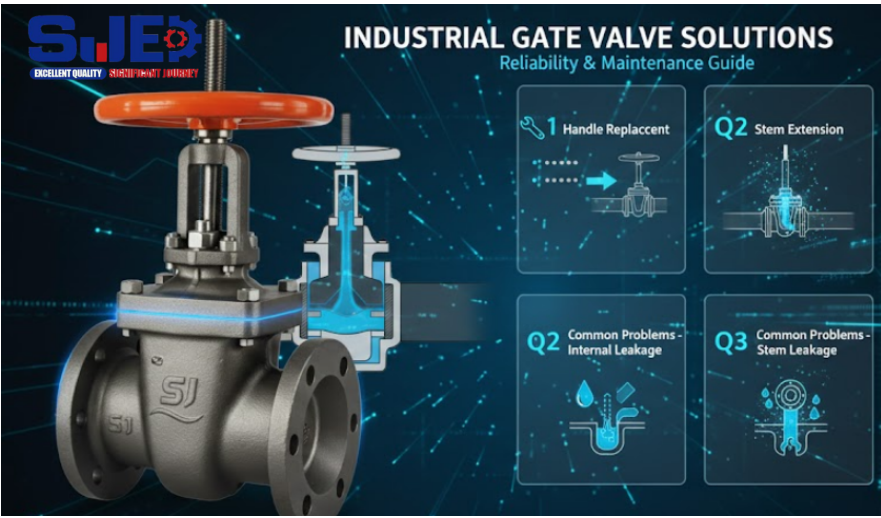
- Q1How to replace a gate valve handle?
- Q2 What is a gate valve stem extension?
- Q3 What are common gate valve problems?
As a reliable partner in the global fluid control field, SJ Valve not only provides excellent valve products but is also committed to providing you with full lifecycle maintenance support. Based on the four core issues most frequently reported by customers in actual operation, the SJ team has compiled this professional guide.
Q1 How to replace a gate valve handle?
At SJ Valve, we adhere to the design principle of "ease of maintenance." Replacing the handwheel is one of the most common operations in the daily maintenance of gate valves. The steps are as follows:
- Depressurize: Ensure the pipeline is not under pressure.
- Disassembly: Use a wrench to remove the fixing nut at the top. If there is rust, a lubricant can be used.
- Replacement: Remove the old handwheel and align the new handwheel with the square head of the valve stem and insert it.
- Fastening: Retighten the nut, ensuring there is no looseness during operation.
SJ Valve Summary: The handwheels produced by SJ Valve feature an ergonomic, anti-slip design and are treated with a high-standard anti-corrosion coating (such as epoxy resin spraying). Our standard parts have high interchangeability, ensuring that customers can achieve "seamless connection" during maintenance and updates, reducing downtime.

Q2 What is a gate valve stem extension?
In pipeline networks buried deep underground or installed at high altitudes, a valve stem extension is a crucial component for enabling remote manual operation. It extends the drive shaft, raising the operating point to a safe and convenient location.
Structure: Consists of an extension shaft, a protective sleeve, and a top operating head.
Value: Allows for valve switching without the need for excavation or temporary platform construction.
Value: Allows for valve switching without the need for excavation or temporary platform construction.
SJ Valve Summary: SJ Valve provides customized stem extension solutions. Our extension rod system supports various lengths and features a patented sealed protective sleeve, ensuring precise transmission even in damp and harsh underground environments. Choosing SJ Valve means choosing greater flexibility and safer operational capabilities.


Q3 What are common gate valve problems?
In industrial fluid systems, although gate valves are known for their robustness and durability, they can still experience some typical problems under extreme operating conditions or after long-term service. SJ Valve has summarized the following four core failures and provides professional diagnostic advice:
In industrial fluid systems, although gate valves are known for their robustness and durability, they can still experience some typical problems under extreme operating conditions or after long-term service. SJ Valve has summarized the following four core failures and provides professional diagnostic advice:
1. Internal Leakage across Seats
This is the most troublesome problem for maintenance personnel. Even when the valve is fully closed, media still flows out downstream.
This is the most troublesome problem for maintenance personnel. Even when the valve is fully closed, media still flows out downstream.
Root Causes: Impurity Damage: Weld slag, sand, or scale in the pipeline scratches the gate or valve seat during the closing process.
Wire Drawing: The valve is frequently in a partially open or closed state, and the high-pressure media creates a "wire drawing" effect, eroding grooves.
SJ Expert Diagnosis: Check if the valve is being used as a control valve. Gate valves are only designed for fully open or fully closed operation.

2. Stem Packing Leakage
Media leaks upwards along the valve stem, not only wasting resources but also potentially corroding external valve components.
Media leaks upwards along the valve stem, not only wasting resources but also potentially corroding external valve components.
Root Causes:
Packing Wear: Frequent opening and closing causes the packing to lose elasticity or become worn.
Loose Packing Gland: Vibration during operation may cause the gland bolts to loosen.
SJ Prevention Solution: SJ Valve uses a self-compensating flexible graphite packing system. If minor leakage occurs, simply adjusting the gland nuts evenly is usually sufficient to restore the seal.

3. High Operating Torque or Seizure
The valve is unusually heavy to open manually, or even completely impossible to turn.
The valve is unusually heavy to open manually, or even completely impossible to turn.
Root Causes:
Dry Threads: The trapezoidal threads in the valve stem yoke lack lubrication.
Bent Stem: The operator uses an excessively long lever arm for forceful operation, causing permanent deformation of the valve stem.
Thermal Binding: The valve is closed under high-temperature conditions, and after cooling, the internal components contract and compress, making it difficult to reopen.
SJ Valve Summary: Addressing industry pain points, SJ Valve incorporates precision grinding technology during the design phase, achieving micron-level fit between the gate and valve seat, fundamentally reducing internal leakage. At the same time, we utilize a self-lubricating packing system, which greatly reduces the risk of external leakage and the frequency of maintenance, reflecting SJ Valve's rigorous pursuit of quality.
SJ Valve has always insisted on technology-driven manufacturing, and our gate valve series products are widely used in water treatment, petrochemicals, and municipal construction.