SJ VALVE Launches Full-Range Industrial Butterfly Valve Series
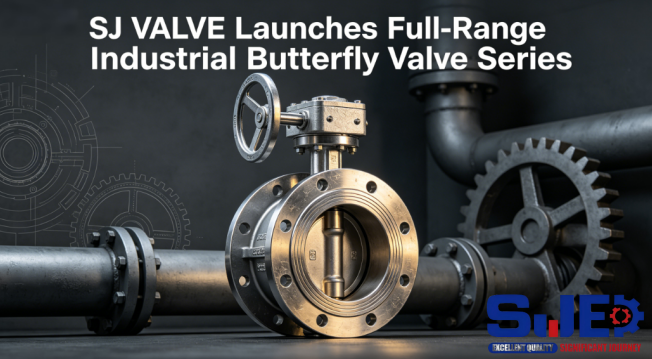
SJ VALVE Launches Full-Range Industrial Butterfly Valve Series
2.Q2: What is the difference between wafer and lug butterfly valve connections? How do we choose?
3.Q3: Eccentric butterfly valves sound advanced – what is the real difference compared to ordinary concentric butterfly valves?
4.Conclusion
In industrial pipeline systems, the choice of valve directly impacts not only operational safety but also system layout, energy consumption, and maintenance convenience. Butterfly valves, with their compact structure, fast operation, and low flow resistance, play an irreplaceable role in many flow regulation and shut-off applications – from large-diameter clean water transport in municipal supply networks, to precise chilled/hot water flow control in HVAC systems, to reliable isolation of particle-laden media in petrochemical plants. In all these cases, a stable, easy-to-operate, and durable butterfly valve is essential for smooth system operation.
Q1: Where are large industrial butterfly valves typically used in ordinary factories and engineering projects?
A: Regulating large flow in water supply & drainage pipelines, controlling chilled/hot water flow in HVAC systems, and providing reliable shut-off for high-temperature/high-pressure media in petrochemical lines.
Butterfly valves are used across a very wide range of industrial applications, from municipal works to heavy chemical industries.
In water treatment and municipal engineering, butterfly valves are key components in water supply and drainage systems. Large-diameter soft-seated butterfly valves are widely used in raw water intake, sedimentation tank sludge discharge, filtration, and finished water transmission in water treatment plants, as well as for on/off and throttling in wastewater treatment plant process lines. Their high flow capacity and low resistance make them ideal for smooth water transport and fast shut-off.
In HVAC systems, butterfly valves play a central role in energy-efficient operation. In central air conditioning chilled water systems and hot water circulation systems of large commercial buildings, airports, hospitals and other public facilities, butterfly valves are combined with temperature sensors to achieve automatic flow regulation, providing fast response and improved energy efficiency.
In petrochemical applications, butterfly valves are equally important. Triple-offset metal-seated butterfly valves are widely used for flow control and emergency shut-off in crude oil and natural gas pipelines – they are pressure-resistant, tight-sealing, and can handle corrosive media such as hydrogen sulfide. In refinery FCC units, they are paired with electric actuators for precise flow regulation.
In power generation, butterfly valves are heavily used in circulating cooling water systems, flue gas desulfurization (FGD) systems, and steam lines of thermal power plants, providing regulation and isolation for large-flow media under high-temperature, high-humidity conditions.
Other common applications include steel & metallurgy (blast furnace gas systems), food & pharmaceutical (sanitary butterfly valves), marine seawater piping, and many more – wherever compact structure and fast operation are valued.