What is a self-priming pump and How does it work
What is a self-priming pump and How does it work
What is a self-priming pump? How does it work?
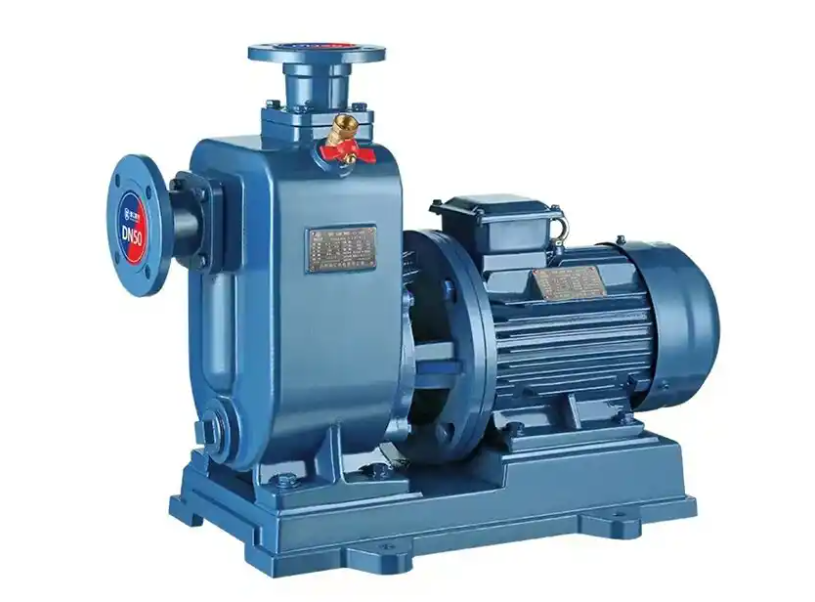
Self-priming pump is a self-priming centrifugal pump, the pipeline does not need to install the bottom valve, before work only to ensure that the pump body is stored in a fixed amount of priming liquid can be. Self-priming pumps can be made of different materials for different media and liquids. Self-priming pump is a pump that can generate suction by itself. It utilizes the energy of the flowing liquid to generate a vacuum, which in turn generates the suction force required for the pump to work.
After the self-priming pump is started, the impeller rotates at high speed, mixing the liquid pre-stored in the pump with the air in the suction pipe. Under the action of centrifugal force, the gas-liquid mixture is thrown to the outer edge of the impeller, forming a liquid ring and entering the separation chamber. Due to the sudden drop in flow rate, the lighter gases are separated and discharged from the outlet, while the liquid flows back into the pump and passes through the impeller to mix with the remaining air again. This cycle continues until the air in the pipeline is exhausted, the liquid is continuously transported, the pump enters the normal operating state. The core of the pump is to realize “self-priming” through repeated mixing and separation of gas and liquid, and automatic evacuation of gas.
Application scenarios
1. Sewage treatment and drainage system: it can suck in gas-containing liquids (e.g. biogas-mixed sewage) to avoid cavitation damage; it is suitable for catchment wells or temporary drainage scenarios with large fluctuations in water level.
2. Agricultural irrigation and water conservancy: no need to install a fixed foot valve, directly from the open water source pumping; to adapt to the high sediment content of the water body, reducing the dependence on filtration; no need to manually inject water before startup, suitable for remote areas or frequent start-stop irrigation system.
3. Chemical and corrosive liquid transportation: the pump body material can be stainless steel and other corrosion-resistant materials; gas-liquid separation design to reduce the impact of volatile gases on the pump efficiency; sealing structure to prevent leakage, to ensure safety.
4. Ship and marine engineering: the pump body can still be stable and self-priming under tilting or shaking environment; it can deal with mixed liquids containing oil and salt; it is suitable for ship ballast water, bilge sewage discharge, and treatment of oily wastewater from offshore platforms.
Advantages and disadvantages
Advantages
1. No need for external water injection
No need to manually fill the pump or install a bottom valve before starting, simplifying the operation process, especially suitable for remote areas or emergency conditions.
2. Strong anti-cavitation ability
can deal with gas-containing liquids (such as methane gas in sewage, chemical volatile gases), reducing the damage of cavitation on the pump body.
3. Adaptation to complex working conditions
Suitable for intermittent operation, water level fluctuation or high suction range scenarios (e.g., construction drainage, agricultural irrigation).
4. Low maintenance cost
Simple structure, no bottom valve design to reduce the risk of clogging; the pump can store liquid after shutdown to avoid frequent water injection.
Disadvantages
1. Relatively low efficiency